
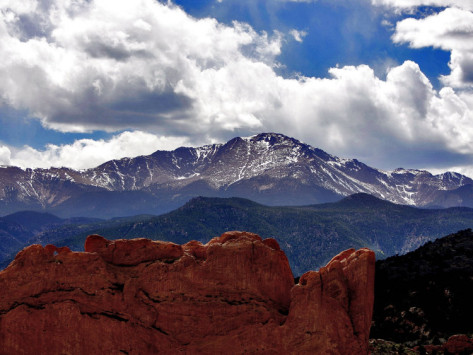
So you’re livin’ up in the clouds now eh? Cakes aren’t rising right or breads have over-risen. You don’t need to create a whole new recipe for your living arrangements but you will need to make some adjustments. King Arthur Flour has a great page dedicated to high altitude baking. I definitely recommend it!
Baked goods tend to rise faster, requiring a change in the proportion of ingredients used in leavened foods; i.e., cakes and breads.
Since baking items often rise quicker at higher altitudes, you may want to increase the oven temperature. So, at elevations over 3500 feet, the oven temperature for batters and doughs should be 25 degrees Fahrenheit higher than the temperature used at sea level.
Proofing time for yeast breads should be reduced. For breads and things that rise, you’ll want to adjust the rapid rise time so it doesn’t make the bread or cake too dry. So for yeast breads, watch your dough and judge the rise time by the change in the dough’s bulk. What could take 2 hours to double here in Pittsburgh may only take under an hour in Denver (Hi to my friend Lora in Denver 🙂 )
For stuff using leavening agents (Baking powder) do NOT overbeat the eggs. Doing so will add too much air to the bread and cake. Increase the temperature. The higher heat/faster cooking time will keep the recipe from rising too much. I would also decrease your baking powder slightly – even if by a 1/4 of a teaspoon
Plus always grease your pans or use parchment paper as breads/cakes tend to stick more.
Unfortunately I can only provide advice from a logical, engineering way having never lived in High Altitude areas (though given my choice I would LOVE to live in Colorado – absolutely GORGEOUS area!). This tends to ‘make sense’ to me. If you live in the high altitude areas and have more practical experience please by all means share!
- Add an additional egg to rich cakes to help keep them from falling
- Increase flour: For each cup of flour increase by 1 tablespoon
- Decrease fat: For each cup of fat, decrease 1 to 2 tablespoon
- Reduce baking powder: For each teaspoon, decrease 1/8 teaspoon to 1/4 teaspoon
- Reduce sugar: For each cup, decrease 0 to 1 tablespoon
- Increase liquid: For each cup, add 2 to 4 tablespoon
- Increasing oven temperature 15 to 25°F more will help set the batter before cells formed by leavening gases expand to much
I found this online from a pamphlet on High Altitude food preparation
| Adjustment | |||
| Reduce baking powder, for each teaspoon, decrease | 1/8 teaspoon | 1/8-1/4 teaspoon | 1/4 teaspoon |
| Reduce sugar, for each cup, decrease | 0-1 Tbsp. | 0-2 Tbsp. | 1-3 Tbsp. |
| Increase liquid, for each cup, add | 1-2 Tbsp. | 2-4 Tbsp. | 3-4 Tbsp. |
Some more tips:
To convert standard recipes into those which can be used for high-altitude baking:
- Use 5% more flour – to disperse the leavening action and slow down the rapid rise of the cake
- Use 20% more water – to counterbalance the rapid evaporation of liquids at high altitudes and the extra flour added to the cake batter
- Bake about 25 degrees higher – to help “set” the cake’s crust
- Reduce baking time about 20% – prevent overbaking at the higher temperature
- Fill pans 1/3 to no more than 1/2 full – to avoid batter overflow caused by rapid cake expansion
- Use cold water and large cold eggs – to give cake extra strength
- Generously grease and flour cake pans – to prevent cake from sticking
- Since high altitude cakes rise higher, remove top oven rack to prevent cake from sticking to it
- Have oven calibrated by a serviceman periodically, since some thermostats are affected by altitude.
High-altitude cookie adjustment
Only cookies with lots of chocolate, nuts or dates need adjustment: reduce baking powder/soda by 1/2.
At very high altitudes, a slight reduction of sugar may help.




Leave a Reply