

Whether you’re roasting your first turkey or are a seasoned pro, use this as your guide on how to thaw a turkey properly!

How to Properly defrost a turkey
So Thanksgiving is just a few days away, and it’s time to talk turkey. If you are like the majority of the population, you’ve already bought your frozen bird and have it nestled in your freezer. The question is, what’s the best way to defrost it? Now, there is truly only one acceptable and safe way; however, there are a few ways out there that scare me.
Let me tell you what NOT to do first…

NEVER DO THE FOLLOWING:
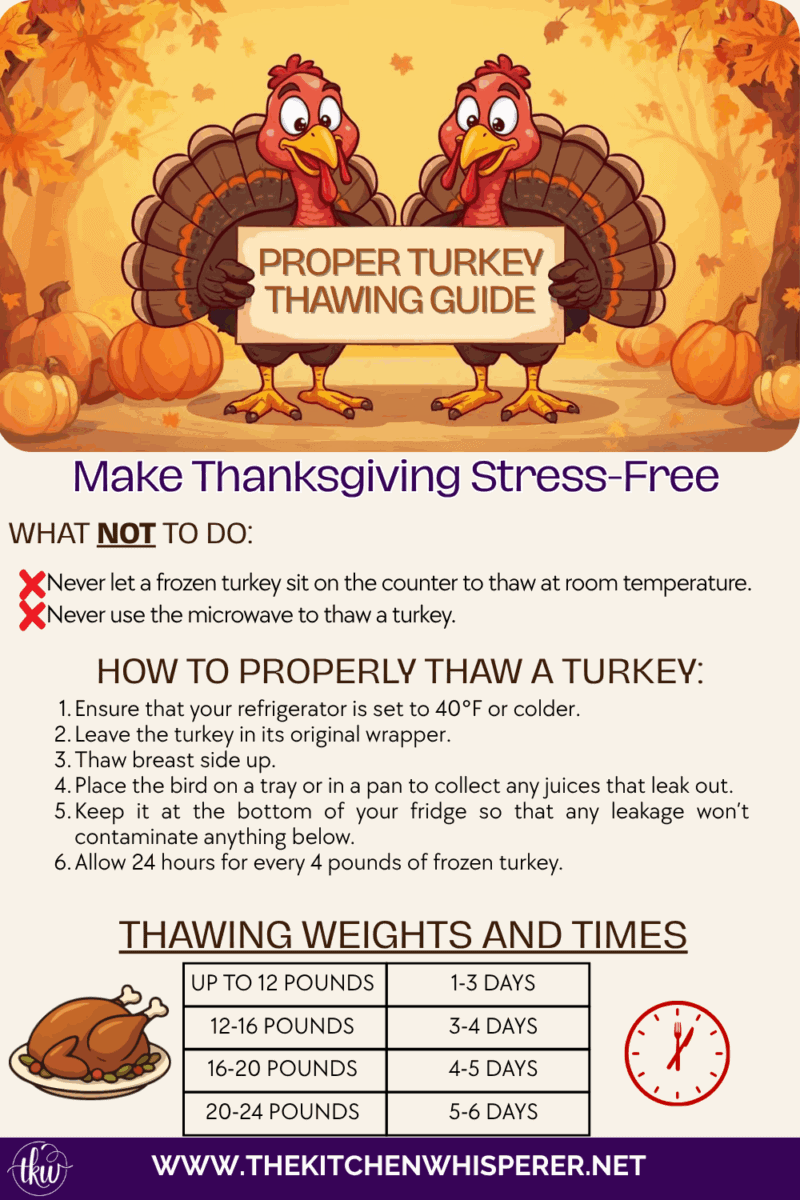
- Never let a frozen turkey sit on the counter to thaw at room temperature.
Uncooked meat or poultry (including frozen) shouldn’t be left at room temperature for more than two hours. Any longer than that and you’re just begging for a case of food poisoning. *Shudder* Don’t do this. Like… EVER! - Never EVER try to thaw your turkey in the microwave.
Yes, people have done this, and I seriously want to Face Palm them with this. What’s going to happen is that some parts will thaw, some will start to cook, and others will remain frozen. Seriously, don’t do this. - Defrost in Cold Water.
Okay, so this is how my Mom always did it, and while it “technically” can be done safely, it’s a true PITA! You MUST AT ALL TIMES keep the water at 40°F or colder for it to thaw evenly and properly without introducing food-borne bacteria! The problem is, you need to allow 30 minutes of thawing time for every pound of frozen bird, and you must keep the water at 40°F or colder the entire time. For a large turkey, that means monitoring the temperature with an instant-read thermometer and changing the water every half hour for 12 hours!
What’s so special about 40°F? That’s the lower limit of the Food Temperature Danger Zone. If the turkey gets any warmer than that, it gives dangerous bacteria a chance to multiply like crazy. So, unless you’re strictly committed to changing the water up to 24 times, it’s best to avoid this method.
This method is faster than refrigerator thawing but requires more attention. The food must be in a leakproof package or plastic bag. If the bag leaks, bacteria from the air or the surrounding environment could be introduced into the food. Also, the meat tissue may absorb water, resulting in a watery product. The bag should be submerged in cold tap water, changing the water every 30 minutes so it continues to thaw. Small packages of meat, poultry, or seafood – about a pound – may thaw in an hour or less. A 3- to 4-pound package may take 2 to 3 hours. For whole turkeys, estimate about 30 minutes per pound. If thawed completely, the food must be cooked immediately. Foods thawed by the cold water method should be cooked before refreezing.

The Best and Safest Way to Thaw a Turkey
Thawing in the refrigerator is the only safe way to defrost a frozen turkey. Here’s how to do it:
- Ensure that your refrigerator is set to 40°F or colder.
- Leave the turkey in its original wrapper.
- Thaw breast side up.
- Place the bird on a tray or in a pan to collect any juices that leak out.
- Keep it at the bottom of your fridge so that any leakage won’t contaminate anything below.
- Allow 24 hours for every 4 pounds of frozen turkey.
Here are the basic weight guidelines for refrigerator thawing:
Turkey Weight Thawing Time Up to 12 lbs 1-3 days 12 to 16 lbs 3-4 days 16 to 20 lbs 4-5 days 20 to 24 lbs 5-6 days
To calculate your exact thawing times, use this site: http://www.butterball.com/how-tos/thaw-a-turkey





Leave a Reply